
First reflections on RDD 2026: Nanopharm’s contribution to accelerating OINDP development and approvals was repeatedly highlighted by the U.S. FDA as the Agency announced draft and revised draft updates to product-specific guidances and discussed a clearer roadmap for NGP pMDIs.
It is just a few weeks since the team got back from Arizona, and as the fog of jetlag subsided, we reflect on what proved to be another thought-provoking event, which has culminated in a series of significant announcements from the FDA, underlining the value of the pioneering work we have undertaken at Nanopharm as part of our ongoing collaboration.
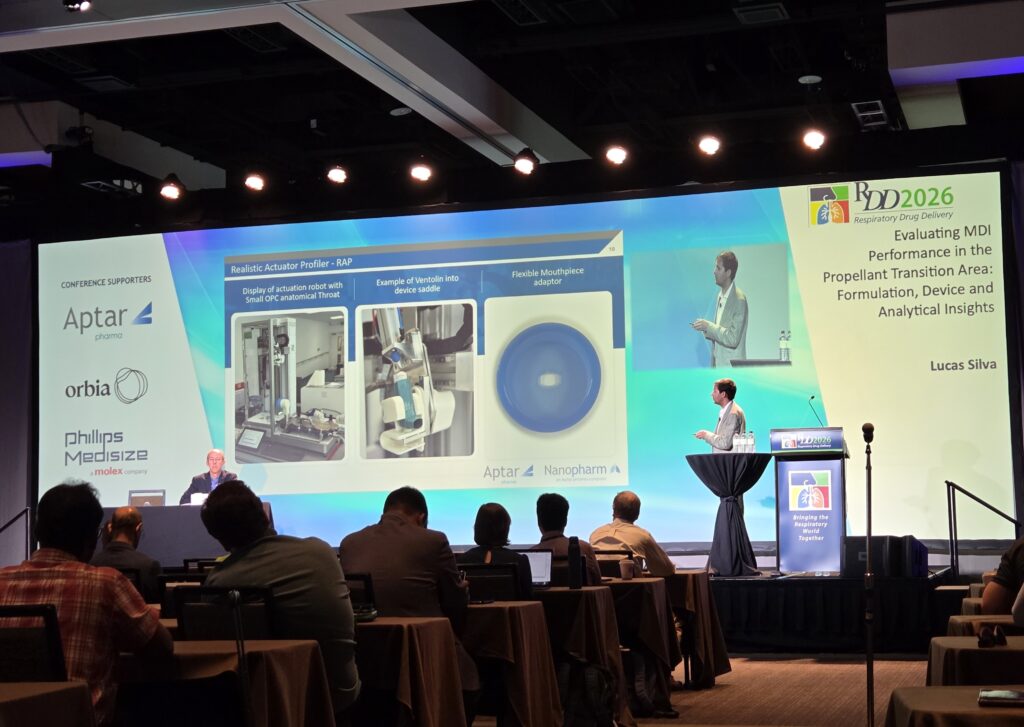
Nanopharm took to the stage alongside three representatives from U.S. Food & Drug Administration (FDA) at this year’s Respiratory Drug Delivery (RDD®) conference, underlining its important scientific contribution to research supporting the development and evaluation of pressurized metered dose inhalers (pMDIs); particularly those employing next-generation propellants (NGPs).
RDD® is the premier global gathering for specialists exploring pioneering science in the field of orally inhaled and nasal drug products (OINDPs), with this year’s event taking place in Phoenix, Arizona from May 10-14.
The morning session of the final day was dedicated to the theme of ‘Building a Sustainable Future’. This explored the evolving science and regulation around pMDIs, with 2026 marking the 70th anniversary of the first product being launched onto the market by Riker Laboratories in 1956.
In a presentation entitled Evaluating MDI Performance in the Propellant Transition Era: Formulation, Device and Analytical Insights, Lucas Silva, Manager, Technical Specialists, gave attendees an overview of some of the outputs of Nanopharm’s FDA sponsored research programme exploring the impact of NGPs on product performance based on novel in vitro and in silico bioequivalence techniques.
Subsequent presentations by FDA then expanded on this same programme and published additional data generated by Nanopharm, explaining how this scientific output has supported FDA’s ongoing evaluation of critical measures of bioequivalence, and ultimately contributed to proposed updates to streamline certain expectations for industry.
The evidence base has been significant in building understanding of the factors that are, and are not, influential in driving respirability and, ultimately, lung deposition for pMDI drug products. It also details how to reliably test those parameters in the laboratory by developing robust analytical methods that are more clinically-relevant, and introduced Nanopharm’s proprietary RAP(TM) automated actuator as an example of how to achieve this.
The importance of Nanopharm’s research was also highlighted in connection with the key parameters that would demonstrate bioequivalence between NGP versions of on-market reference pMDIs, rather than considering forthcoming NGP variants as new products requiring full clinical development – which, until now, has been viewed by many in industry as a major barrier to market entry.
Significantly, one week after the event on May 21, the FDA announced the availability of 71 new and revised draft product-specific guidances (PSGs) for generic drug development. Certain pMDI related PSGs were updated to remove recommendations relating to in vitro spray pattern and plume geometry, and prime-reprime studies, as certain PSGs were also updated to include partial AUC measurement for the PK element. These developments reflect FDA’s data-driven approach to evaluating bioequivalence recommendations – an area Nanopharm has been proud to support the underlying scientific research.
Lucas said: “RDD is where the key issues in respiratory drug delivery are tackled. It was great to participate in such an important discussion, and it is incredibly rewarding that Nanopharm’s scientific expertise has been recognized in connection with FDA-sponsored research intended to support regulatory expectations around the development of generic pMDIs, including those employing NGPs where there had been a lot of uncertainty stopping companies from progressing in the transition. The development pathway for generics companies is now clearer and more readily achievable than ever before. We know these devices are life saving for patients and our work is ensuring they will continue to do so in a sustainable way for many decades to come.”
In the coming weeks we will reflect further and deeper on Lucas’s presentation, sharing more insights on our work and the notable acknowledgments from the FDA regarding Nanopharm’s contributions to this important area of research.
