
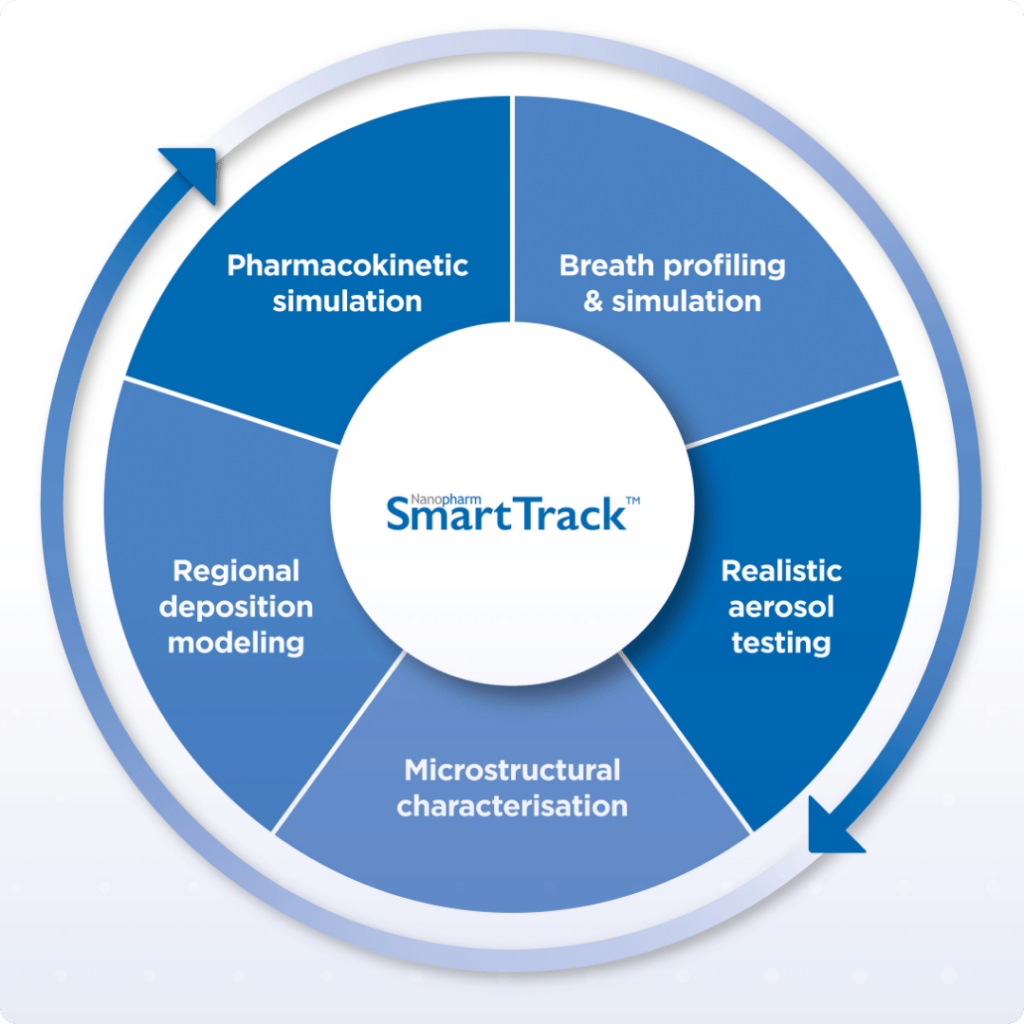
Dr. Jag Shur, Vice President, Science & Technology at Nanopharm, and Dr. Will Ganley, Head of Computational Pharmaceutics, recently discussed SmartTrack™ and Nanopharm’s extended capabilities in support of alternative bioequivalence at a workshop which was held jointly between the FDA and the Center for Research on Complex Generics (CRCG) at the University of Maryland, Baltimore and the University of Michigan.
Jag Shur’s presentation focused on realistic in vitro tools. Our partner Jan De Backer from FLUIDDA spoke on their in silico CFD models for studying regional deposition in patient-specific models.
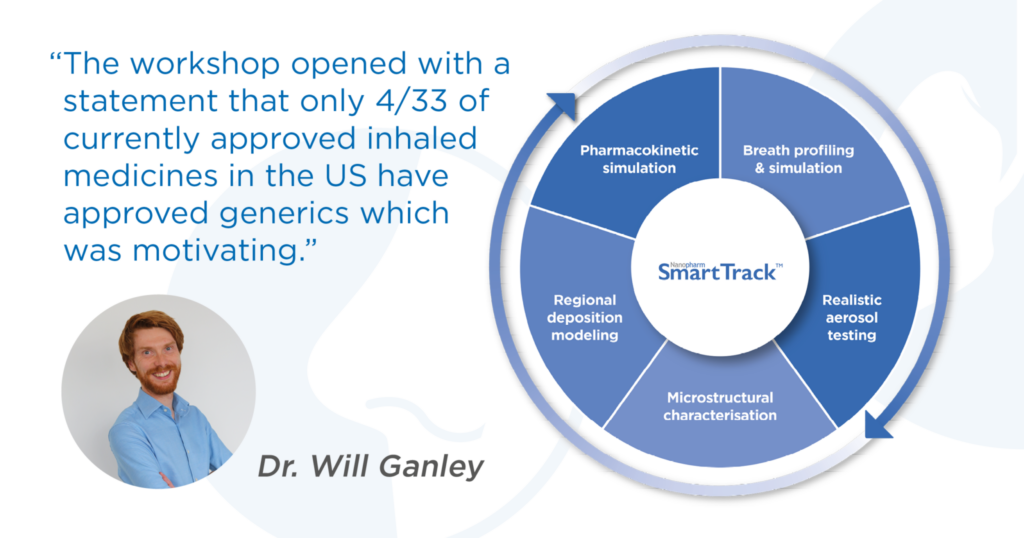
Will Ganley, whose presentation on how in silico patient-specific PBPK models form part of a platform as an alternative to CCEP BE studies for inhaled generics, said this about the event itself: “The event was unique in that of the 85 in-person attendees a large proportion of them were from the FDA. This allowed us to have conversations and ask questions during the sessions and over lunch or coffee, which I had never experienced before. The workshop opened with a statement that only 4/33 of currently approved inhaled medicines in the US have approved generics which was motivating.”
Will said, “The talks covered a wide range of topics from the shortcomings of current bioequivalence approaches to novel or alternative in silico, in vitro and in vivo studies that could help us better demonstrate bioequivalence for orally inhaled products. There was a lot of healthy discussion, especially during the small group discussions and panel sessions. There were a lot of differences of opinion on the best way to bring the industry’s expertise together to solve this problem, but it was clear that the basic research is mainly done. We have already established the tools we need to make this happen. The final challenge is figuring out how to bring them all together for each of the remaining products that don’t have approved generics.”
“Overall, the event was excellent. We covered a lot of ground, and the attendees were keen to share experience and opinions. My perspective has shifted on a few things. Still, I am confident that Nanopharm’s approach of bringing relevant in vitro studies and in silico methods together ticks all the boxes.”
More information about the event can still be found here.
Related Posts

Balancing Creativity with Compliance: Meet Kirsten Searle, Manager of Pharma Development
Discover how Kirsten Searle is enhancing project management excellence at Nanopharm. Hear about her philosophy on balancing pragmatic process with scientific innovation in a fast-paced CRO environment.

Inhaled Generic Bioequivalence Modeling Approaches
Learn how advanced in vitro and in silico modeling help generics companies overcome complex bioequivalence hurdles for orally inhaled drug products (OIDPs).

First Reflections on RDD 2026: FDA Guidance Updates Highlight Progress for NGP pMDIs
Discover first reflections on RDD 2026 from Phoenix, Arizona, highlighting the impact of the research programme funded by FDA and exemplifying Nanopharm’s recognized scientific contributions to supporting the transition to next-generation propellant metered dose inhalers (pMDIs).