
Reducing actuation variability in pMDI bioequivalence testing through automation
When a patient depends on a pressurised metered dose inhaler (pMDI) for their medication, they actively participate in every delivered dose – and human behaviour is inherently variable.
Unlike an injection administered by a healthcare professional or a transdermal patch that passively delivers its therapy (on the skin), successful drug delivery via a pMDI requires an coordinated sequence of actions from the patient.
For a suspension-based pMDI, this includes shaking the device, coordinating actuation with inhalation, and maintaining a breath-hold before exhaling. The precision and repeatability of these actions vary not only from one individual to another, but also from dose to dose within the same patient.
For inhaled drug products, the variability during the inhalation procedure can have a significant impact on the extent of the dose that reaches the lungs, and where indeed in the lungs it deposits. In a laboratory setting, when trying to demonstrate bioequivalence of a generic product to an innovator, or when trying to optimise performance of a new product such as reformulating with the next generation propellants (NGPs); that patient variability also translates to analyst variability on the bench. This is a problem for pharmaceutical companies and regulators when they try to develop and execute test methods and ultimately interpret data.
Many factors and variables must be considered and evaluated to demonstrate that the critical quality attributes (CQAs) of the product are scrutinised under “realistic” conditions. These conditions, as outlined in the swathe of updated product specific guidances (PSG) released by US FDA in 2024 and 2025, require the use of additional instruments and accessories such as breathing simulators and anatomical throat models, including the VCU and OPC models, when performing realistic aerodynamic particle size distribution (rAPSD) testing.
Coordination of actuation with inhalation is an area where in vitro testing for bioequivalence can be particularly challenging, not just for patients but also for analysts, because everything happens in a fraction of a second. This is the trigger point for aerosol generation, and where on the inhalation curve this happens can influence aerodynamic particle-size distribution (APSD), the oral / throat deposition profile and, ultimately, the extent to which a drug becomes available at the site of action.
Actuation cannot, however, be evaluated in isolation.
Pre-actuation, the shaking manoeuvre can be highly variable, and for some pMDIs this may result in incomplete re-suspension of the drug and ultimately inconsistent delivered doses. These points of connection between device and lab equipment can be engineered manually, but with significant risk of introducing analyst variability. And while automation of the “shake and fire” process presents a viable alternative option, commercially available automated actuators have so far been limited in their ability to provide a fully integrated solution because they have been unable to integrate all the necessary steps into a complete solution. Specifically, they cannot connect to all anatomical throat models or breathing simulators, since they were designed to support QC testing using USP throat models, which are not deemed “realistic” by regulatory agencies.
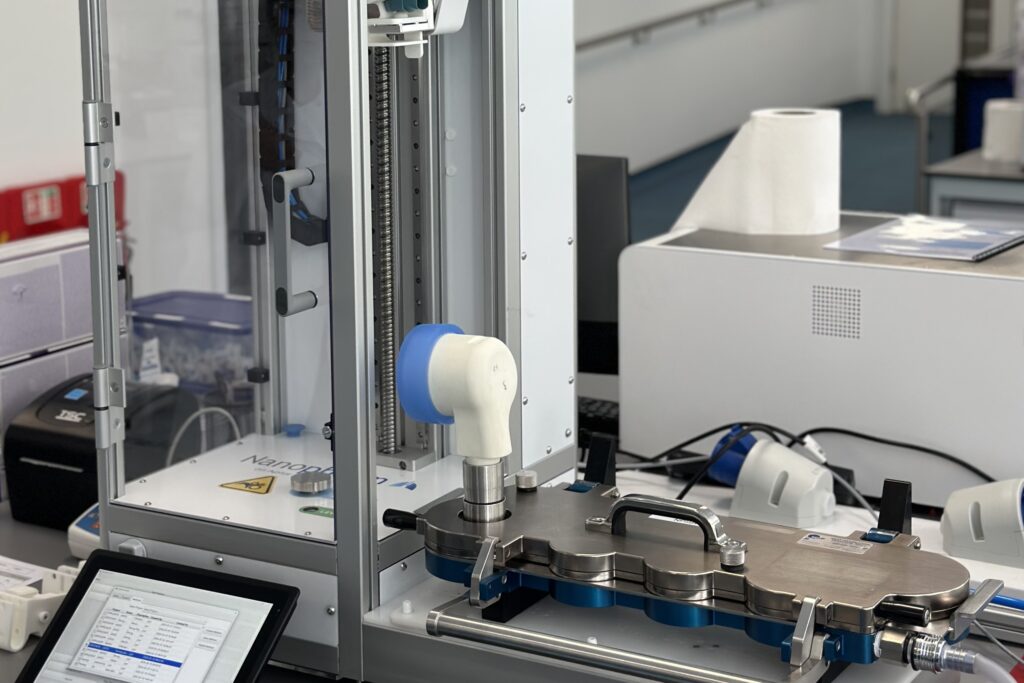
To address this gap, Nanopharm has introduced its patent-pending Realistic Actuator Profiler (RAP). RAP is a novel tool that automates the end-to-end process of shaking and actuating pMDIs, featuring automatic connection to breathing simulators and anatomical throat models. This fully integrated functionality meets a crucial, and as-yet unmet need in demonstrating in vitro bioequivalence. This includes eliciting robust measurement of realistic APSD parameters, including Mass Median Aerodynamic Diameter (MMAD), Geometric Standard Deviation (GSD), Fine Particle Fraction (FPF) and Mass Balance as a percentage of the Total Delivered Dose (TDD), as well as shot weight.
In tests using RAP, pMDI devices are handled using reliable and programmable robotics, removing many of the points where human error can potentially undermine the process. Here, the full range of variables can be controlled, including shaking angle, speed and duration as well as actuation point, firing force and hold time. As a result, actuation is performed to a consistent, repeatable level, meaning the overall integrity and quality of the actuation analysis is enhanced.
Zooming out from the specifics of actuation, RAP can be seen in the context of a wider drug product development environment where regulators such as the U.S. Food & Drug Administration (FDA) are increasingly supportive of automated techniques or ‘smart’ approaches that speed and simplify bioequivalence while delivering essential, reliable data that supports safe, effective performance in real-world scenarios. Indeed, this can already be seen in alternative bioequivalence approaches, where in-silico modelling methods such as those pioneered in Nanopharm’s SmartTrack™ platform are receiving regulatory endorsement as a means of accelerating generic development and reducing the burden around costly, time-consuming and risky comparative clinical endpoint (CCEP) studies.
There is no escaping the fact that demonstrating bioequivalence remains an inherently complex area, with pressure to provide regulators with robust, data-rich evidence that inhaled drug products meet the critical benchmarks for performance and safety. Uniquely, however, Nanopharm’s cutting edge technological methods enable pharmaceutical partners to rise to these challenges by providing an integrated, holistic, end-to-end approach.
Equipped with advanced tools such as RAP and SmartTrack™, patent holders and generics companies have a valuable opportunity to simplify and accelerate the approval process and supercharge their ambitions to bring next-generation MDIs to market in the most cost and time-efficient way.
